Pricing is the elephant in the room that most contractors avoid until they are standing in your backyard. This “Ostrich Marketing” approach, burying one’s head in the sand to avoid tough questions, only breeds doubt and frustration for you, the buyer. When you cannot find clear information, trust disappears.
After 22 years of building decks across the Greater Cincinnati area, we’ve watched homeowners spend weeks comparing brands when the harder question is whether the contractor will be straight with them about cost. So let’s start there.
If you are researching a project locally, you deserve to understand the “Law of the Coin.” Every material has two sides: composite decks offer incredible durability and freedom from rot, but they require a significantly higher upfront investment than traditional wood.
The Financial Landscape: 2026 Industry Data
In 2026, a standard 200-square-foot custom deck in a moderately competitive market like Cincinnati typically ranges between $15,000 and $35,000. Materials typically account for 40% to 50% of your total project invoice.

The remaining balance covers the skilled labor required for high-end craftsmanship, structural permitting, and specialized equipment.
Trex: The Industry Standard
Trex is a capped composite made from wood fibers and recycled plastic. It is often the first brand that homeowners encounter because it offers a tiered approach to budgets of all sizes.
- Trex Enhance: This “basics” line uses a scalloped or fluted bottom to reduce material weight. It is a popular entry point for those tired of maintaining pressure-treated lumber.
- Trex Select: A solid-profile board with a thicker protective shell than the Enhance line.
- Trex Transcend: The premium heavy-hitter. It features the thickest protective cap and deep, realistic wood-grain patterns.
| Product Line | Est. Material Cost (sq. ft.) | Total 200 sq. ft. Project (Est. Installed) |
| Enhance | $5.50 to $6.50 | $15,000 to $19,000 |
| Select | $8.00 to $9.50 | $21,000 to $26,000 |
| Transcend | $12.00 to $14.50 | $30,000 to $36,000 |
Where Trex falls short: The Enhance line, despite the price appeal, has a noticeably plastic look up close, and the scalloped bottom traps moisture in low-clearance builds. Color fading on the entry-level line is more noticeable after five to seven Cincinnati summers than on premium tiers.
Pro Tip from our crew: If your deck sits low to the ground with minimal airflow, skip scalloped boards. We’ve torn out enough Enhance installs over the years to know that trapped moisture eventually shows up as mold or stained joists underneath.
TimberTech: Capped on Four Sides
TimberTech offers a hybrid wood-plastic core with one defining advantage: most of its lines are capped on all four sides. This means the bottom of your board is just as protected from moisture as the top.
- TimberTech Prime+ / Premier: Solid entry-to-mid-tier boards with strong color depth and reliable heat performance.
- TimberTech PRO (Legacy or Reserve): Premium collections known for superior slip resistance, multi-tonal wirebrushed finishes, and a 30-year fade and stain warranty.
| Product Line | Est. Material Cost (sq. ft.) | Total 200 sq. ft. Project (Est. Installed) |
| Prime+ / Premier | $7.00 to $8.50 | $19,000 to $23,000 |
| PRO Series | $10.50 to $13.00 | $28,000 to $33,000 |
Where TimberTech falls short: The mid-tier finishes can look repetitive across a large surface area because the grain pattern repeats more frequently than that of premium Trex options. The PRO Reserve line’s wirebrushed texture, while beautiful, requires gentle cleaning; a stiff brush will dull the cap over time.
Pro Tip from our crew: TimberTech’s four-sided capping is what we lean on for Cincinnati builds with low ground clearance. Snowmelt and humidity are real concerns here, and that bottom cap genuinely matters for the board’s long-term life.
Azek: The Advanced PVC Choice
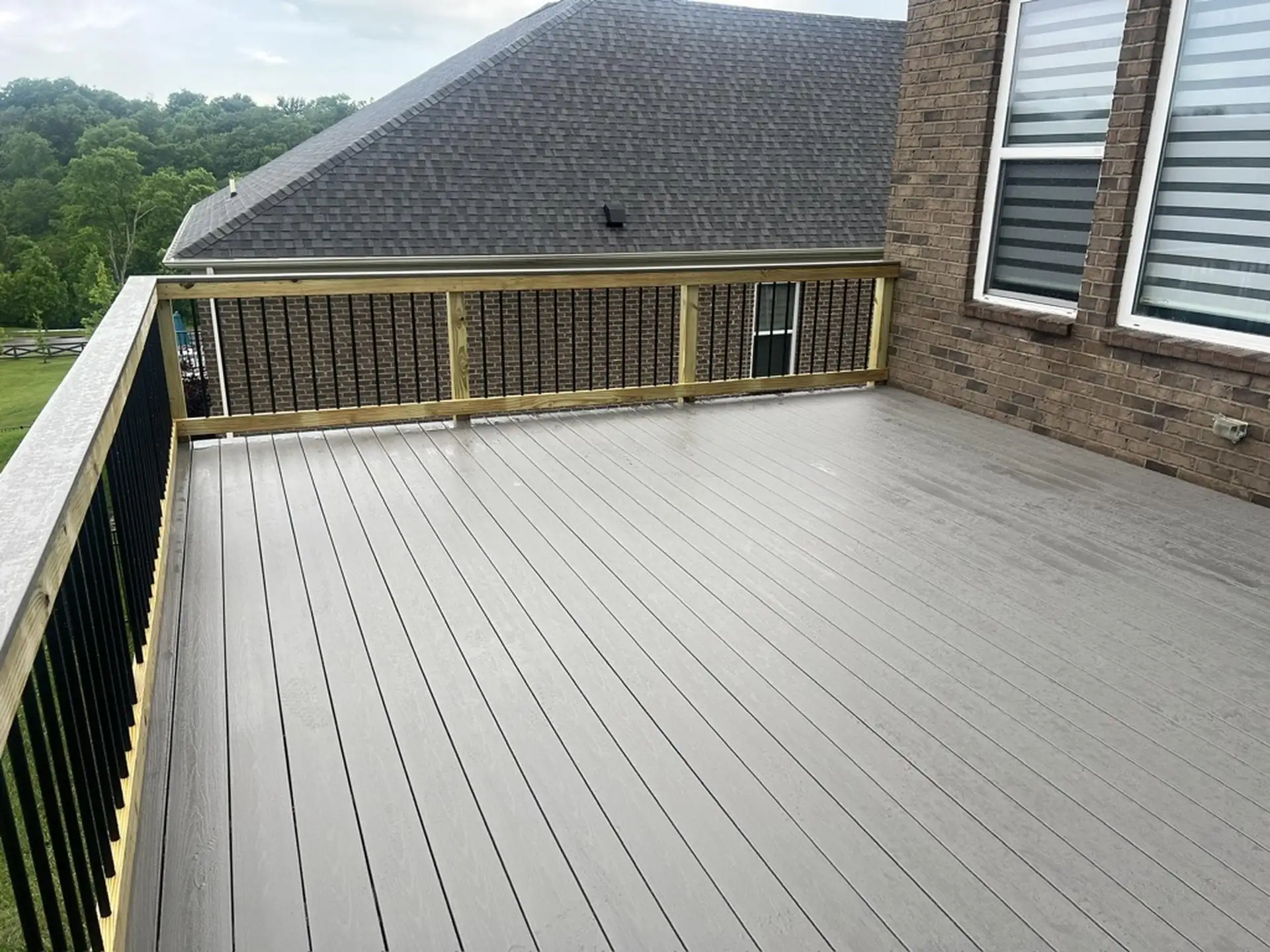
Azek is a “capped polymer,” meaning it contains zero wood fibers. It is made of 100% cellular PVC. This makes it the most resistant option for Cincinnati’s humid summers and snowy winters because there is no organic material for rot or mold to feed on.
- Landmark Collection: Features a matte finish with a distinct cross-cut grain.
- Vintage Collection: Often considered the top of the synthetic decking category. It stays up to 30 degrees cooler than standard composites and carries a 50-year limited warranty.
| Product Line | Est. Material Cost (sq. ft.) | Total 200 sq. ft. Project (Est. Installed) |
| Azek Landmark | $14.00 to $16.50 | $34,000 to $40,000 |
| Azek Vintage | $17.00 to $19.50 | $42,000 to $50,000 |
Where Azek falls short: The price is the obvious one. Azek can run close to double the cost of an equivalent TimberTech PRO build, and not every homeowner sees a visual difference that justifies the gap.
Pure PVC also expands and contracts more aggressively than wood-fiber composites, which means installation gaps must be precise; a sloppy installer leaves you with visible movement in the joints come July. Some homeowners find PVC has a slightly slicker feel underfoot than composite, especially when wet. And while sophisticated, the color palette is narrower than what Trex Transcend offers.
Pro Tip from our crew: We recommend Azek when a homeowner plans to stay in the home for 15+ years, has a sun-exposed deck where heat retention matters, or wants the closest thing to a “set it and forget it” surface. For shorter horizons or shaded builds, the cost-to-benefit math usually favors TimberTech PRO.
What Actually Drives Your Quote?
Beyond the surface boards, several technical factors will move your investment up or down:
- Framing Systems: While wood is traditional, Aluminum Framing is the new benchmark for luxury builds. It is corrosion-proof and perfectly level, typically adding $18 to $28 per square foot.
- Railing Choice: Basic vinyl is functional, but high-end Black Aluminum or Cable Railing creates a modern, custom feel for $65 to $130 per linear foot.
- Elevation: A second-story build requiring structural footings and complex stairs can cost 40% more than a platform deck at ground level.
- Cincinnati-Specifics: Local building codes and HOA requirements often require detailed 3D renderings for approval.
Common Homeowner Questions
Is composite really worth double the cost of wood?
If you plan to stay in your home for over five years, yes. Wood is cheaper upfront but expensive later; maintenance costs for sanding and staining every two years quickly exceed your initial savings. Plus, composite is safer for feet and pets because it resists rot and splinters.
Does the color of the board affect the price?
Usually, no. Within specific lines like Trex Transcend, colors typically cost the same. However, darker boards absorb more heat. In Cincinnati’s peak summer, dark boards can stay 30 degrees warmer than lighter shades, which is a major factor if your deck lacks shade.
Why did one contractor quote me $10k less for the same materials?
This is a red flag for the “elephant in the room,” the substructure. Low quotes often mean cutting corners in hidden areas, using fewer support joists, skipping structural permits, or using low-grade fasteners that will eventually corrode. After 22 years and 500+ decks built across the Tri-State, we’ve been called in to repair more than a few of these “great deals.”
What is the technical requirement for joist spacing?
Composite is more flexible than wood. While wood may allow 24-inch spacing, composites usually require 16 inches on center for straight runs and 12 inches for diagonals or stairs. Correct spacing prevents sagging and keeps your manufacturer’s warranty valid.
How do you prevent water from rotting the house frame where the deck attaches?
We use proper ledger board flashing. By applying corrosion-resistant metal flashing with a drip edge and specialized flashing tape over the ledger and joists, we create a waterproof seal. This prevents moisture from reaching your home’s rim joist, the top cause of deck failure.
How long does a build take?
Permitting and planning take the most time, but the actual on-site construction for a standard custom deck is typically finished within 2 weeks.
The Kingstruction Approach
A custom outdoor space is one of the largest additions you’ll ever make to your home. Over 22 years and 500+ builds across Cincinnati, we’ve learned that the best projects start with homeowners who are informed before they ever talk to a contractor. That’s why we publish this kind of pricing breakdown openly.
When you’re ready to see how Trex, TimberTech, or Azek looks in real Cincinnati settings, our Project Gallery is the best starting point. To learn about the family behind the work, visit our About page, which covers our history and approach. If budget flexibility matters, take a look at our financing options before scheduling.
Once you have a sense of what you want, request a detailed estimate or explore our custom deck services. We’ll show up on time, keep your yard clean every day we’re there, and tell you exactly what your project will cost before you sign a thing.